
What is Central Sleep Apnea (CSA)?
Central Sleep Apnea is a breathing disorder that causes your body to stop breathing during sleep.
Central sleep apnea (CSA) is a sleep-related breathing disorder where the brain temporarily stops sending the signals that tell your breathing muscles to work. Unlike obstructive sleep apnea, your airway is open — the problem is in the brain-to-muscle communication, not in physical airflow.
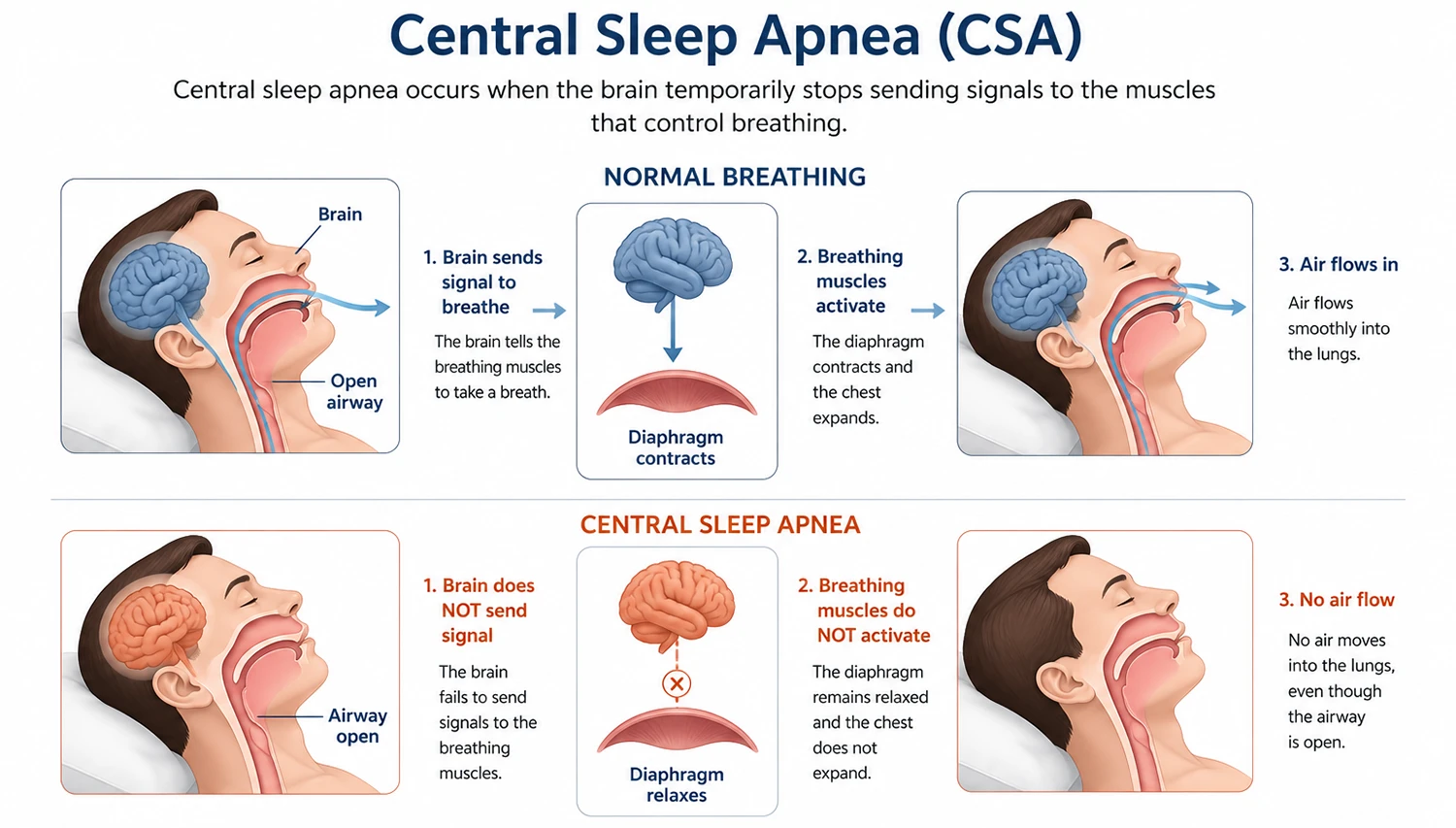
Central sleep apnea vs obstructive sleep apnea
This is the most useful distinction to understand. In obstructive sleep apnea (OSA), the throat tissues collapse and physically block the airway while you continue trying to breathe. In central sleep apnea, the airway stays clear, but your respiratory effort itself temporarily stops — your chest doesn't rise, because the brain hasn't told it to.
OSA is far more common. CSA accounts for a small minority of sleep apnea diagnoses and is often linked to an underlying medical condition.
What causes central sleep apnea?
- Heart failure — particularly congestive heart failure, often producing a distinctive breathing pattern called Cheyne-Stokes respiration
- Stroke or other neurological conditions affecting the brainstem
- Opioid medications — long-term use of strong painkillers can suppress the brain's breathing drive
- High altitude — periodic breathing at altitude is a common, usually temporary cause
- Treatment-emergent CSA — central events that appear after starting CPAP therapy for what initially looked like straightforward OSA
- Idiopathic CSA — cases where no clear underlying cause can be identified
Common symptoms
Many CSA symptoms overlap with OSA, but with some differences:
- Witnessed pauses in breathing during sleep, often without snoring
- Sudden awakenings with shortness of breath
- Difficulty falling or staying asleep (insomnia)
- Excessive daytime sleepiness and fatigue
- Poor concentration and morning headaches
- Chest discomfort at night in some cases
The absence of loud snoring is a key clue — CSA is often quieter than OSA because the airway isn't vibrating against a partial obstruction.
How is central sleep apnea treated?
Treatment for CSA is more specialised than for OSA and must be guided by a sleep physician. Standard fixed-pressure CPAP is often not the right therapy. Depending on the underlying cause, treatment may involve:
- Managing the underlying condition (heart failure, medication review)
- BiPAP / BiLevel machines with a backup respiratory rate
- Adaptive Servo-Ventilation (ASV) therapy in selected patients
- Supplemental oxygen therapy
- Avoiding alcohol and sedatives that further depress breathing
Adaptive Servo-Ventilation is not suitable for every CSA patient — there are specific cardiac contraindications, which is why a current prescription from a sleep specialist is essential before starting any therapy for central sleep apnea.
Need more information?
If you're new to sleep apnea generally, our sleep apnea overview is a good place to start. If you already have a diagnosis or specialist prescription and need help sourcing the right equipment, contact our team — we'll help you match the prescription to the right machine.