Flying with Your CPAP Machine: Domestic & International Guide
Having sleep apnea doesn't mean you're grounded. Whether you're jumping on a quick domestic hop to visit family, heading interstate for work, or boarding a long-haul international flight, your CPAP therapy can — and should — come with you. The key is knowing the rules, understanding what to expect from your airline and aircraft, and packing the right gear before you leave. This guide covers everything you need to know about flying with your CPAP machine on Australian domestic routes and international flights.
Rule Number One: Always Carry Your CPAP On Board
Before anything else: your CPAP machine should always travel as carry-on luggage, never in checked baggage. Checked bags get thrown, stacked, and exposed to temperature extremes in the hold (we've all seen the videos) — not ideal for sensitive electronic medical equipment. More importantly, if your checked bag is delayed or lost, you have no therapy for the duration of your trip.
The good news is that on all major Australian airlines, a CPAP machine is classified as a medical device and does not count towards your standard carry-on baggage allowance. You can bring it on board in addition to your normal carry-on and personal item, at no extra charge. Keep a copy of your prescription or a letter from your sleep physician in your CPAP bag — it's rarely asked for, but worth having if you're pulled aside for additional screening.
Domestic Flights in Australia: Don't Assume There's Power
This is the most important thing to understand about flying domestically with a CPAP: the majority of Australian domestic flights do not have in-seat power available. This includes most services operated by Qantas, Virgin Australia, Jetstar, and Rex. If you plan to use your CPAP in the air on a domestic flight, you will almost certainly need a battery.
Check Your Aircraft Type Before You Book
The aircraft type makes a significant difference, particularly on regional and shorter domestic routes. Here's what you're likely to encounter:
- Rex Airlines operates primarily Saab 340 turboprop aircraft on regional routes — compact 30-seat twin-engine planes with no in-seat power whatsoever. Rex has also been modernising with ATR turboprop aircraft, which similarly do not offer passenger power outlets. If you're flying Rex to a regional destination, a fully charged CPAP battery is essential.
- Qantas domestic operates a mix of Boeing 737-800s (the primary workhorse on most routes), newer Airbus A321XLR aircraft (entering service from late 2025), and Airbus A220-300s via QantasLink on regional routes. Regardless of aircraft type, domestic Qantas services do not provide in-seat power for passenger use — all CPAP use on domestic Qantas flights must be battery-powered.
- Virgin Australia domestic operates a Boeing 737 fleet — primarily 737-800s alongside newer 737-8 MAX aircraft — with Embraer E190s on some regional routes. As with Qantas, power is not available on Virgin domestic services — battery operation only.
- Jetstar operates a mix of Airbus A320-200s (the backbone of their domestic fleet), Airbus A321/A321LR aircraft on longer routes, and Boeing 787-8 Dreamliners on select domestic services. No in-seat power is available for passengers on Jetstar domestic services regardless of aircraft type.
The best way to confirm what aircraft you're on and whether your specific seat has a power outlet is to check directly with your airline — most publish seat maps and aircraft configuration details on their website when you manage your booking. For international flights especially, it's worth calling the airline directly to confirm power availability at your seat before you rely on it for overnight therapy.
Airline Policies — Domestic
Policies are broadly consistent across Australian domestic carriers, but there are some differences worth knowing:
- Qantas: No advance clearance required to carry or use a CPAP on domestic Qantas flights. Battery-operated use is permitted across all domestic fleet types. Lithium batteries exceeding 160Wh are not permitted on any Qantas aircraft.
- Virgin Australia: Battery-operated CPAP use is permitted. If you plan to use your device in-flight, complete Virgin's Personal Medical Equipment Form and notify the airline at least 48 hours before departure.
- Jetstar: Battery-operated CPAP use is permitted. Submit Jetstar's CPAP Clearance Form before your flight if you plan to use the device in the air.
- Rex: CPAP machines are permitted on board. Contact Rex directly to confirm current requirements for in-flight use, particularly given recent fleet and ownership changes.
As a general rule: if you plan to use your CPAP in the air on any Australian domestic service, notify your airline in advance and complete any required forms. Most airlines ask for at least 48 hours' notice.
International Flights: Power Is Available — But Don't Rely On It
International long-haul flights are a different story. Most wide-body aircraft used on international routes — such as the Qantas Boeing 787 Dreamliner, A380, and A330 — do have in-seat power outlets. However, there are important caveats:
- Power availability varies by seat and class. Business and first class seats generally have reliable power; economy seats may not all have outlets, or outlets may deliver limited wattage.
- Power can be interrupted. Crew may ask you to disconnect during taxi, takeoff, and landing. In-seat power is not guaranteed to be available for the full flight.
- Always have a battery as backup. Even on aircraft with in-seat power, a charged CPAP battery ensures your therapy continues regardless of what happens with the outlet.
Qantas International
Qantas is one of the more CPAP-friendly international carriers. In-seat power outlets (115V AC) are available on their A380, A330, B787, and B737 international aircraft, and CPAP devices can be connected to these outlets. To use in-seat power for your CPAP on a Qantas international flight, complete the Qantas CPAP Travel Clearance Form before your trip — this allows Qantas to arrange the appropriate setup at your seat. While you don't need a doctor's note to carry the device, a medical letter is a sensible addition for international travel.
Other International Airlines
Most major international carriers including Emirates, Singapore Airlines, Cathay Pacific, and Air New Zealand permit CPAP machines as carry-on medical devices and have in-seat power available on long-haul aircraft. Policies on pre-notification and clearance forms vary by airline. The consistent advice across all carriers: contact your airline directly before you fly, confirm their current CPAP policy, and always bring a battery regardless of whether power is available on your aircraft.
Lithium Battery Rules for Flying — What You Must Know
This section applies to both domestic and international travel and is non-negotiable: lithium batteries must always travel in your carry-on — never in checked baggage. This is a requirement from Australia's Civil Aviation Safety Authority (CASA) as well as international aviation regulators, and applies to CPAP batteries, portable power banks, and any other lithium-ion battery.
Battery capacity limits for carry-on are as follows:
- Under 100Wh: permitted without restriction on virtually all airlines. The Medistrom Pilot Flex (98Wh) sits just under this limit and is approved for carry-on on all airlines without requiring advance approval — making it an ideal choice for frequent flyers.
- 100–160Wh: most airlines permit up to two batteries per passenger in this range, though some require prior airline approval. The Medistrom Pilot 12 Lite and Pilot 24 Lite fall in this category — check with your airline before flying.
- Over 160Wh: not permitted on passenger aircraft. This rules out most large general-purpose portable power stations for carry-on use.
Batteries must be protected against short-circuiting — keep them in their original packaging or a purpose-made case, and ensure the terminals cannot make contact with metal objects in your bag. If you're carrying spare batteries, each one must be individually protected.
Getting Through Airport Security with Your CPAP
Australian airport security is generally straightforward for CPAP users. A few things to know before you reach the checkpoint:
- Remove your CPAP from its bag at the X-ray screening point, just as you would a laptop. This speeds up screening and avoids your bag being pulled aside for a manual check.
- Empty your humidifier water chamber before you leave home — not at the gate, not at the checkpoint. Residual water in the chamber can trigger the liquids rule and result in delays. Empty it the night before you travel.
- Distilled water: you cannot bring a full bottle of distilled water through security in your carry-on (it exceeds the 100ml liquid limit). Options include purchasing distilled or purified water at the airport post-security, or using the HumidX waterless humidifier for the AirMini, which eliminates the need for water altogether.
- Carry your prescription or a doctor's letter in an accessible pocket of your CPAP bag. It's rarely requested at Australian domestic airports, but is more frequently asked for at international checkpoints.
- Allow extra time. Most screening goes smoothly, but if your bag is pulled aside for additional checking, having a buffer means you won't be stressed.
Packing Your CPAP for Air Travel
A purpose-designed CPAP travel case is well worth the investment. Standard backpacks and bags don't protect the machine from impact, and CPAP machines are precision medical devices. A hard-shell or well-padded case keeps everything together — machine, tubing, mask, power supply, and battery — and makes airport screening far easier when everything is organised.
For AirMini users, the ResMed AirMini Travel Case is a perfect fit — purpose-built with impact-absorbing EVA foam, water-resistant construction, and enough room for all your accessories. The AirMini Premium Travel Bag is a softer option with shoulder strap for those who prefer a carry bag over a hard case.
A pre-travel packing checklist for your CPAP bag:
- CPAP machine (humidifier chamber emptied and removed or secured)
- Correct power supply and any international voltage adapters needed
- Fully charged CPAP battery
- DC converter cable (useful at your destination if mains power isn't convenient)
- Mask — plus a spare cushion or seal in case of damage
- Tubing
- HumidX if using the AirMini or distilled water (post-security purchase)
- Prescription or medical letter
- Any airline clearance forms already completed
The Case for a Travel CPAP Machine
If you fly regularly, a dedicated travel CPAP machine is worth serious consideration. The ResMed AirMini is the standout option — roughly the size of a large coffee cup, weighing just 300 grams, and FAA-approved for in-flight use. Its compact footprint means it slides into a carry-on bag with ease and leaves room for everything else.
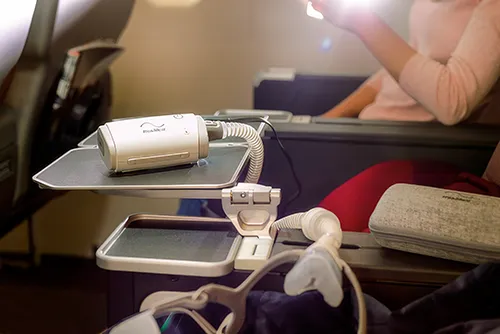
For flying specifically, the AirMini has several clear advantages:
- Small enough to fit under the seat in front of you, on the tray table, or in the overhead locker without taking up meaningful space
- Uses the HumidX waterless humidifier — no water chamber to empty, no liquid worries at security
- Works with the Medistrom Pilot Flex battery (98Wh, fully carry-on compliant) for reliable battery-powered therapy on any flight
- Runs on 24V DC via the AirMini DC/DC converter if in-seat power is available internationally
Many CPAP users keep their full-size machine at home and travel exclusively with the AirMini — it simplifies packing, eliminates security friction, and handles everything from a 90-minute domestic hop to a 17-hour flight to London.
Frequently Asked Questions
Does my CPAP machine count as carry-on luggage in Australia?
No — on all major Australian airlines (Qantas, Virgin Australia, Jetstar, and Rex), a CPAP machine is classified as a medical device and is permitted as an additional carry-on item on top of your standard baggage allowance, at no extra charge. Always carry it on board rather than checking it in.
Can I use my CPAP on a domestic flight in Australia?
Yes, but you will need a battery — power outlets are not available on domestic Australian services with Qantas, Virgin, Jetstar, or Rex. Notify your airline at least 48 hours before your flight and complete any required medical equipment forms. The Medistrom Pilot Flex (98Wh) is fully carry-on compliant on all airlines without requiring prior approval.
What are the battery rules for flying with a CPAP in Australia?
CPAP batteries must always travel in carry-on luggage — never in checked baggage. Batteries under 100Wh are permitted without restriction. Batteries between 100–160Wh are generally permitted (up to two per passenger) but may require prior airline approval. Batteries over 160Wh are not permitted on passenger aircraft. CASA enforces these rules on all flights departing Australia.
Can I use my CPAP on an international flight?
Yes. Most wide-body international aircraft have in-seat power available, and major carriers including Qantas, Emirates, and Singapore Airlines permit in-flight CPAP use. For Qantas international flights, complete the CPAP Travel Clearance Form before your trip. Regardless of whether power is available on your aircraft, always bring a charged battery — in-seat power can be interrupted and is not guaranteed for the full flight.
Do I need to empty my humidifier before flying?
Yes — empty the water chamber before you leave home, not at the security checkpoint. Residual water triggers the airport liquids rule and can cause delays. For travel, consider the HumidX waterless humidifier for the AirMini, which eliminates the water chamber entirely and removes this concern completely.
Sleep Well at 35,000 Feet
Flying with a CPAP machine requires a little planning, but it's far simpler than most people expect. Know your airline's policy, bring a carry-on compliant battery for any domestic flight, check your aircraft type, complete any required forms in advance, and empty that humidifier before you leave home. Do those things and your CPAP therapy will be as consistent in the air as it is on the ground.
Browse our full range of travel CPAP machines, CPAP batteries, and travel cases to gear up for your next trip.