CPAP Camping & Caravanning in Australia: Power Guide for Every Trip
If you rely on a CPAP machine to manage your sleep apnea, the thought of heading out on a road trip, spending a long weekend in the bush, doing the big lap of Australia, or even living aboard your boat might raise one immediate question: how am I going to power this thing? The good news is that with the right setup, your CPAP goes wherever you go — from powered holiday parks to remote unpowered campsites, multi-week caravan runs, and even out on the water. This guide covers every scenario, from quick Easter getaways to full-time grey nomad life, and walks you through the power options that suit your battery system, your trip length, and your setup.
Know Your CPAP's Power Requirements Before You Leave
Most standard CPAP machines — including the ResMed AirSense 10, AirSense 11, Philips DreamStation 2, and Fisher & Paykel SleepStyle — are designed to run on 240V AC mains power. Away from the grid, you have two choices: convert your battery power to 240V AC using an inverter, or use a DC converter cable to run the machine directly from your 12V or 24V system. (More on why the latter is almost always better in a moment.)
Power draw varies, but as a useful guide:
- Without heated humidifier: most current CPAP machines draw around 20W or less — roughly 1.5–2A on a 12V system per hour. (Older machines can draw more, so it's worth checking your model's spec sheet if you're unsure.)
- With heated humidifier running: consumption jumps to over 100W — roughly 8 to 10 times the draw of the machine alone, and a dramatic increase that will drain your batteries far faster than running without humidification
- Pressure setting: higher prescribed pressures use marginally more power, though this is a smaller factor than humidification
The single most effective way to extend your off-grid runtime is to disable or reduce heated humidification while camping. For most people, this means tolerating slightly drier air, though many find that cool, fresh outdoor air actually makes this less of an issue than it would be at home.
Your CPAP Is Just One Load — Plan Your Whole System
Before diving into the specific power solutions below, it's worth stepping back and thinking about your total power budget — not just what your CPAP needs, but everything else drawing from your battery system at the same time. A typical caravan or camping setup might include:
- Fridge/freezer — one of the biggest continuous loads, running 24 hours a day
- Lighting — LED camp lights and interior van lighting throughout the evening
- Phone and tablet charging — multiple devices, every day
- The non-negotiable pod coffee machine — a surprisingly significant spike load in the morning
- Kettle — another high-draw appliance, even if only used briefly
- Starlink Internet — increasingly common on the road, drawing a steady 50–75W while in use
- Air conditioning — by far the largest load if fitted, and a game-changer for battery sizing requirements
Your CPAP's 20W overnight draw is actually modest compared to many of these. The important thing is to size your battery system for your total consumption, not just the CPAP in isolation. A good rule of thumb for extended off-grid travel is to have enough battery capacity for two to three days of total usage without any solar input — cloudy days, shaded campsites, and long stints under tree cover are all realities on the road around Australia.
Powered Sites: The Simplest Option
If you're staying at a caravan park or campsite with 240V mains power, you don't need any additional gear — simply plug in your standard power supply as you would at home. Most powered sites in Australia offer either 10A or 15A outlets, and a CPAP machine draws well under either limit.
A few practical tips:
- Pack your standard power cord and adapter in a dedicated pouch so it's easy to find at check-in time
- Bring a short power board or extension lead — the outlet at your site isn't always conveniently positioned
- Always carry your DC cable or backup battery even when staying at powered sites; you may move to an unpowered site mid-trip
Unpowered Sites, Free Camping and Off-Grid: Power Options for Every Setup
This is where the planning really matters. The right solution depends on two things: how long your trip is, and what kind of battery system you're running. We've broken it down by trip type below.
Short Trips: Finding the Right Solution for Your Setup
Whether you're heading out for a long weekend or an Easter break, the right CPAP power solution depends less on how long you're away and more on what you've got to work with. Here's how to approach it based on your setup.
Camping — Tent, Swag, or Rooftop
If you're camping without a built-in battery system — just a tent, swag, or rooftop setup — a dedicated portable CPAP battery is your best option. These are compact, self-contained units that don't rely on any existing electrical system in your vehicle.
One important thing to understand: each Medistrom unit provides approximately one night of therapy per charge. For multi-night trips, you'll need to recharge between uses. The two most practical ways to do this on the road are:
- Solar charging: The Medistrom 50W Solar Panel is designed specifically for the Pilot Lite range — set it up in the morning and it'll be ready by nightfall
- Vehicle charging: Plug the battery into your car's 12V outlet while driving between sites to top it up on the go
The most popular Medistrom options available at CPAP Club:
- Medistrom Pilot 12 Lite — for 12V CPAP machines such as the ResMed AirSense 10. Compact and lightweight, approximately one night per charge without humidification.
- Medistrom Pilot 24 Lite — the 24V counterpart, compatible with the ResMed AirSense 11 and AirMini. Similar runtime and form factor.
- Medistrom Pilot Flex (12V/24V) — supports both 12V and 24V devices, weighs under 500 grams, and delivers up to 30% more runtime than the Lite models. Also FAA/TSA compliant for air travel.
Portable Power Stations — Bluetti, EcoFlow & Similar
If you want more capacity than a dedicated CPAP battery but don't have a built-in battery system in your setup, a portable power station is an excellent middle-ground solution. Brands like Bluetti, EcoFlow, and Jackery produce compact lithium power stations ranging from around 500Wh up to 2,000Wh or more — enough to run your CPAP for several nights while also keeping your phone charged, powering a camp light, and handling other small loads.
These units are particularly well suited to campers, rooftop tent setups, and smaller camper trailers that don't yet have a dedicated 12V house battery system. Key advantages include:
- Multi-night capacity: a 500Wh station will cover four or more nights of CPAP use at 20W without humidification, without needing a recharge
- Multiple outputs: most have both 240V AC outlets and 12V DC outputs, so you can run your CPAP via a DC converter cable (preferred for efficiency) or plug in the standard power supply
- Flexible recharging: charge via mains power at home before you leave, via solar panels at the campsite, or via your vehicle's 12V outlet while driving
- Versatility: doubles as a power source for other gear around the campsite — phone charging, portable speakers, camp lighting, and more
As with dedicated CPAP batteries, always use the 12V DC output with a DC converter cable where possible rather than the 240V AC outlet — you'll get better efficiency and more nights per charge from the same battery capacity.
One bonus worth knowing: many portable power stations from brands like Bluetti and EcoFlow include a UPS (Uninterruptible Power Supply) function, which means they can sit permanently plugged in at home and automatically switch to battery power the moment mains power is interrupted. For CPAP users in storm-prone areas of Australia, this makes the unit double as a home power backup — your therapy continues uninterrupted through outages, regardless of whether you're in the middle of a Queensland storm season or a summer bushfire event affecting the grid. It's a compelling reason to choose a UPS-capable model if you're tossing up between options.
Camper Trailer
Most camper trailers come with a 12V AGM or lithium house battery, typically charged by solar panels on the trailer roof and topped up via a DC-DC charger from the tow vehicle while driving. If that's your setup, you already have everything you need — a machine-specific DC converter cable lets you run your CPAP directly from the trailer's house battery without a separate portable battery or an inverter. At roughly 20W without humidification, your CPAP will have a minimal impact on a healthy 12V system. See the 12V systems section below for compatible cables by machine model.
Caravan with a 12V Battery System
A standalone caravan with a 12V house battery works in exactly the same way as a camper trailer — a DC converter cable is all you need to run your CPAP efficiently from the existing system. The advantage here is that caravans typically carry larger battery banks (300Ah or more), giving you greater capacity headroom alongside all your other loads. Again, see the dedicated 12V section below for full details and compatible cables.
Full Inverter/Charger System
If your van or caravan is fitted with a full inverter/charger system — such as a Victron MultiPlus or similar — you'll have a 240V AC outlet available from your battery bank at any time. The simplest option is to plug your CPAP's standard power supply straight in, exactly as you would at home. The one caveat: make sure your inverter produces a pure sine wave output rather than modified sine wave — see the inverter section below for why this matters.
That said, even with a 240V outlet readily available, using a DC converter cable is the more efficient choice. Running your CPAP via the inverter means converting DC to AC, only for your CPAP's power supply to immediately convert it back to DC — each step loses energy as heat. A DC converter cable skips the AC stage entirely, giving you better efficiency from the same battery. It's a small but worthwhile gain, particularly on longer trips where every bit of battery headroom counts.
Browse the full range of CPAP batteries and power options available at CPAP Club.
Extended Caravan Trips: 12V Systems
A 12V house battery system is the most common setup in Australian caravans, camper trailers, and 4WD touring setups. If you have a dual battery or lithium house battery fed by solar or a DC-DC charger, you can run your CPAP directly from this system using a machine-specific DC converter cable — no inverter required, no additional battery needed.
Recommended cables for common machines:
- ResMed AirSense 10: AirSense 10 12V DC Converter — plugs directly into your 12V cigarette lighter or auxiliary power socket
- ResMed AirSense 11: AirSense 11 DC/DC Converter (12V & 24V) — supports both 12V and 24V input, making it useful across a range of setups
- ResMed AirMini: AirMini DC/DC Converter — note the AirMini is a 24V device, so this converter steps up a 12V source to power it correctly
A 100Ah lithium battery running a mid-range CPAP without humidification will typically last 3–5 nights in isolation — but of course, your CPAP is rarely the only thing drawing from your battery. A caravan setup also has to power a fridge/freezer, phone and device charging, lights at night, Starlink Internet, and for many travellers the non-negotiable pod coffee machine. Add air conditioning to the mix and your battery bank needs to be considerably larger. As a rule of thumb, size your battery system for at least two to three days of total consumption without any solar input — bad weather, heavy tree cover, and overcast winter days are realities on the road around Australia, and the last thing you want is to be rationing power on night four of a week-long trip.
Extended Caravan Trips: 24V Systems
Newer high-capacity caravan and motorhome setups increasingly run 24V battery banks, which offer efficiency advantages and lower cable losses at higher loads. For CPAP use, a 24V system is excellent — both the AirSense 11 DC/DC Converter and the AirMini DC/DC Converter accept 24V input natively, so you can plug straight in without any intermediate conversion.
Runtime from a 24V system will be equivalent to a 12V system of similar capacity (in amp-hours). The real benefit is that a 24V, 100Ah lithium bank stores twice the energy of a 12V, 100Ah bank — so if your setup is already 24V, your CPAP runtime is effectively doubled for the same physical battery size.
Extended Caravan Trips: 48V Systems
High-end touring setups and some modern motorhomes use 48V battery systems, which are highly efficient for solar charging and running large loads. The catch for CPAP users is that no current CPAP machine accepts 48V input directly — there are no native 48V DC converter cables available.
If your system is 48V, you have two practical options:
- Step-down DC-DC converter: A 48V-to-12V (or 48V-to-24V) DC-DC converter installed in your van will give you a dedicated lower-voltage output specifically for your CPAP cable. This is the most efficient approach and is worth having wired in if you're fitting out a new van.
- Pure sine wave inverter: Your 48V system's inverter (which outputs 240V AC) can run a standard CPAP power supply. This works well, but is less efficient due to the double conversion (48V DC → 240V AC → internal CPAP DC). Make sure your inverter is a pure sine wave type — a modified sine wave inverter can damage CPAP power supplies over time.
DC Converter Cables vs Inverters: Why It Matters
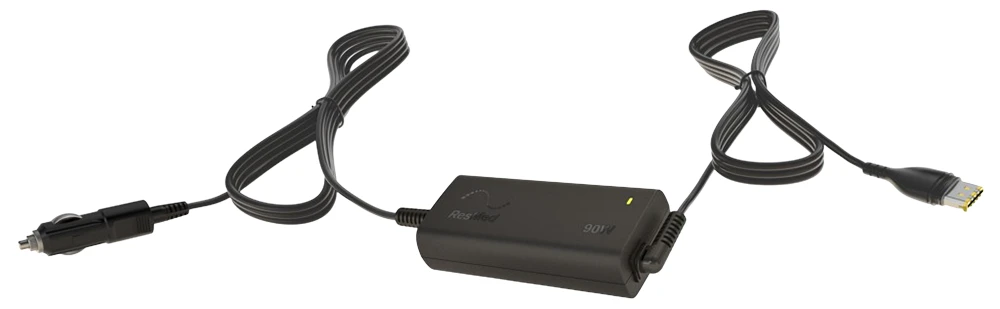
This is the most commonly misunderstood aspect of off-grid CPAP use, and getting it right can add one to two extra nights of runtime from your existing battery.
When you run your CPAP via an inverter, you're converting DC battery power to 240V AC, and then your CPAP's own power supply immediately converts it back to DC internally. Each conversion step loses energy — typically 10–15% per conversion. Run two conversions, and you're losing 20–25% of your battery capacity as heat before the machine even uses it.
A DC converter cable skips the AC stage entirely, going straight from your battery's DC voltage to the voltage your CPAP needs. The result is significantly better efficiency and longer runtime from the same battery.
When you have to use an inverter (e.g., on a 48V system without a step-down converter), always choose a pure sine wave inverter. Modified sine wave inverters produce a stepped waveform that mimics AC but isn't true AC — CPAP machines and their power supplies are sensitive electronics and some models can be damaged or produce abnormal noise when run from modified sine wave power.
Note for Fisher & Paykel SleepStyle+ users: the SleepStyle+ is a 240V AC-only machine — there is no DC converter cable available for it. If this is your machine, you'll need a 240V power source regardless of your battery system voltage. You have three practical options:
- Pure sine wave inverter or inverter/charger: if your caravan or camper has an inverter fitted, simply plug your SleepStyle+ into the 240V AC output as you would at home. Make sure it's a pure sine wave model — see the inverter section above.
- Larger portable power station: units from brands like Bluetti and EcoFlow include a 240V AC outlet, making them a convenient off-grid solution for SleepStyle+ users without a built-in inverter. As a bonus, models with UPS function also double as a home backup during power outages.
- Switch to a travel CPAP for camping trips: some SleepStyle+ users find it easier to travel with a travel CPAP machine such as the ResMed AirMini, which runs on 12V or 24V DC and is purpose-built for off-grid use. Keep the SleepStyle+ at home and pack light for the road.
Keeping Your Battery Charged: Solar on the Road
A current CPAP machine drawing around 20W overnight for eight hours uses approximately 160Wh of energy — or roughly 13Ah on a 12V system. Even a modest 100W solar panel on a sunny Australian day can generate 400–600Wh, which is well more than enough to replace a full night of CPAP use with plenty left over for your other loads. As noted above though, your CPAP is just one draw on the system — factor in the fridge, lighting, and device charging when sizing your solar setup, and build in enough battery buffer for the days when the sun doesn't cooperate.
If you plan to run your CPAP with heated humidification, the equation changes significantly. At over 100W, an eight-hour night can draw more than 800Wh — around 67Ah on a 12V system. In that case, a 100Ah lithium battery dedicated to your CPAP is a sensible minimum to ensure you get a full night's sleep without risking fully draining the battery. Running a lithium battery flat regularly will shorten its lifespan, so having adequate headroom matters — and this is especially true for AGM batteries, which should never be discharged below 50% State of Charge. Regularly deep-cycling an AGM battery will significantly reduce its usable life and capacity over time.
A few practical solar tips for CPAP campers:
- Use an MPPT solar charge controller rather than a PWM type — MPPT is significantly more efficient, particularly in partial shade or overcast conditions
- On cloudy days or in shaded campsites, account for lower solar input and consider whether a larger battery bank provides a better buffer
- A portable solar panel or solar blanket is useful if you're moving sites frequently — roll it out, point it at the sky, and roll it back up at sundown. It also gives you flexibility to position the panel in direct sun if you're parked under trees for shade, where rooftop-mounted panels would be largely ineffective
Travel CPAP Machines: A Game-Changer for Off-Grid Camping
If you travel frequently or spend extended periods off-grid, a travel CPAP machine is worth serious consideration. The ResMed AirMini is the standout option in this category — it's roughly the size of a large coffee cup, weighs around 300 grams, and is the world's smallest CPAP machine.
For camping and caravanning, the AirMini has several specific advantages:
- Lower power draw: The AirMini uses less power than a full-size machine, extending battery runtime
- 24V DC input: With the AirMini DC/DC Converter, it plugs directly into any 12V or 24V outlet in your caravan or vehicle
- HumidX waterless humidification: The HumidX is a small heat and moisture exchange device that fits inside the mask connector — no water chamber to fill, no spillage risk, and no additional power load from a heated humidifier
- Compact packing: Fits in a daypack, which matters when space in a caravan bay or boat cabin is limited
Some people use an AirMini exclusively on the road and keep their full-size machine at home; others switch to an AirMini for all their travel. Either approach works well.
Boating and Marine Use
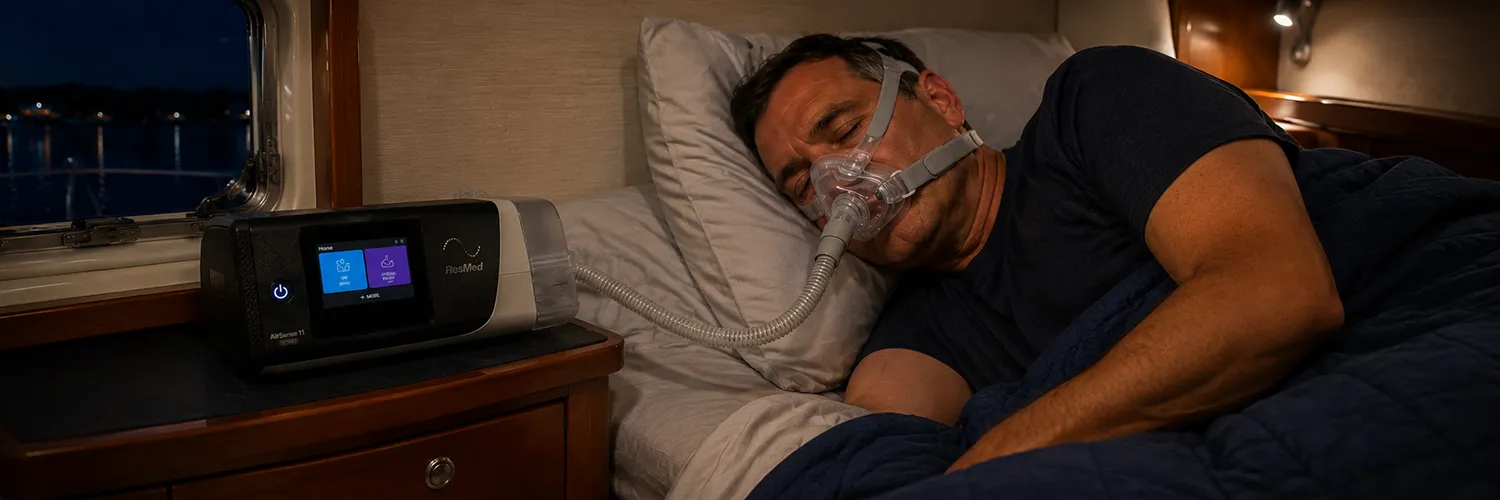
Running a CPAP aboard a boat is entirely achievable, and more boaters are doing it than you might think. Most vessels with a live-aboard capability already have a 12V or 24V house bank, and the same DC converter approach that works in a caravan works just as well at anchor or on a mooring.
A few marine-specific considerations:
- Moisture and salt air: Store your CPAP machine in a dry, ventilated location away from direct spray. A quality CPAP travel case offers good protection against humidity and physical damage below decks
- Shore power: When tied up at a marina with shore power (240V), plug straight in as normal
- At anchor or on a mooring: Use your DC converter cable running from the house bank — a 100Ah lithium house bank will typically run a CPAP without humidification for 3–5 nights, depending on your machine and pressure setting
- Backup battery: A Medistrom Pilot Flex or Pilot 24 Lite makes an excellent onboard backup for nights when you've been running high loads during the day and want to be certain of full CPAP runtime overnight
- The AirMini advantage: The AirMini's compact footprint is a genuine benefit in a boat's cabin — it takes up almost no space and the HumidX eliminates the need to manage a water chamber in a moving environment
Practical Packing Tips
Regardless of your trip type, a little preparation before you leave prevents headaches on the road:
- Test your setup at home — ideally a week or two before you leave, and preferably twice — run your CPAP from your battery or power bank for a full night and make sure everything works as expected. If something doesn't work, a cable is incompatible, or your battery isn't holding charge, you'll have time to order a replacement and have it delivered before departure. Finding out the night before you leave is stressful; finding out at a campsite three hours from town is worse.
- Pack both your DC cable and your standard AC power supply — you may end up at a powered site, stay with friends, or need to charge at a power point along the way
- Empty your humidifier water chamber before travelling — water in a sloshing humidifier chamber can find its way into the machine
- Carry a spare mask cushion or seal — a leaking mask wastes effort and noise when you're in an enclosed van or tent
- Note your machine's power adapter specs — the input voltage range is printed on the adapter. Most modern CPAP power supplies are universal (100–240V), which matters for road trips where power quality at campgrounds can vary
For more general advice on taking your CPAP equipment on the road, see our Travelling with CPAP guide.
Frequently Asked Questions
Can I run my CPAP machine from my car's cigarette lighter socket?
Yes — with a compatible DC converter cable, most popular CPAP machines can run directly from a standard 12V cigarette lighter socket, also known as a vehicle auxiliary socket. A similar connector style is the merit connector, which grips the plug more securely and is a popular upgrade for this reason. Note that these connector types can work loose overnight, so it's worth checking the connection is firm before you go to sleep.
There is also an important power limit to be aware of: cigarette lighter and merit-style sockets may only be rated to 10A / 120W. Running a CPAP without humidification sits well within this limit, but adding heavy humidification and a high flow rate can push consumption beyond 120W — at which point you risk blowing the socket fuse or, in a worst case, overheating and melting the plug. If you plan to run humidification, make sure the socket you're using is rated to at least 15A to give yourself adequate headroom. For sustained overnight use without a house battery, run the engine periodically to avoid draining your starting battery.
How many nights will a portable CPAP battery last?
It depends on your machine, your pressure setting, and whether you're running a heated humidifier. As a general guide, a Medistrom Pilot Flex provides around one to two nights of therapy at typical pressures without humidification. Turning off heated humidity can more than double runtime. Larger portable power stations (400–600Wh) can deliver three to five nights or more.
Do I need to turn off my humidifier when camping off-grid?
Not necessarily — but it's highly recommended if battery runtime is a concern. The heated humidifier is by far the biggest power draw on a CPAP machine, often consuming more energy than the machine itself. Disabling it (or switching to a HumidX waterless humidifier on the AirMini) can extend your off-grid runtime by 200–400%. Many campers find the cooler, fresher outdoor air means they don't need as much humidification anyway.
Can I use a modified sine wave inverter with my CPAP?
It's not recommended. Modified sine wave inverters can cause buzzing, interference, and — with extended use — damage to sensitive CPAP power supplies. If you need to use an inverter, always use a pure sine wave model. Better yet, use a DC converter cable to avoid inverter losses altogether.
What is the best CPAP machine for off-grid camping in Australia?
For off-grid use, the ResMed AirMini is hard to beat. It's compact, draws less power than a full-size machine, accepts 12V or 24V DC input via converter, and works with the HumidX waterless humidifier to eliminate the power load of a heated water chamber. That said, if you already own a full-size machine like the AirSense 10 or AirSense 11, adding the appropriate DC converter cable is often all you need for comfortable off-grid therapy.
Sleep Well Wherever the Road Takes You
A sleep apnea diagnosis doesn't mean you need to stick to powered sites or stay home when the rest of Australia is out exploring. Whether you're doing a weekend bush camp with a Medistrom battery, running your AirSense from a lithium house battery on a lap of Australia, or keeping your CPAP charged from a 48V system in a premium motorhome — there's a solution that fits your setup.
The key is knowing what your machine needs, choosing the right connection method for your battery voltage, and keeping humidification in check on unpowered nights. Get those three things right and your CPAP therapy will be as consistent in the middle of the outback as it is at home.
Browse our full range of CPAP batteries and power solutions or explore travel CPAP machines to find the right setup for your next adventure.