Best Auto CPAP Machines for 2026: Our Two Standout Picks
Here's the good news before you read another word: if you're shopping for an auto CPAP machine in 2026, you almost can't go wrong. The current generation of auto-adjusting (APAP) machines from ResMed, Fisher & Paykel, Philips and Löwenstein are all genuinely excellent — quiet, smart, comfortable, and clinically capable. Pick any current model and you'll be in good hands. So this isn't a guide about avoiding a bad machine, because there really aren't any bad ones left. It's about two machines that, in our experience, go a step beyond the rest — one for outright comfort and ease of use, and one for proven, flexible, set-and-forget therapy. If you want the best auto CPAP machine for the year ahead, these are the two we keep coming back to.
First, what actually makes an auto CPAP machine "the best"?
An auto-adjusting CPAP machine (APAP) raises and lowers your pressure breath by breath, matching what your airway needs at any given moment rather than holding one fixed setting all night. Most current models do this very well, so the differences that actually matter day to day come down to four things:
- How quiet it is — and here's the catch most spec sheets hide: rated decibels are measured at a single steady pressure, but an auto machine's pump speeds up and slows down all night as your breathing demand changes. A machine can be near-silent at rest yet have an audible "breathing" quality as the motor ramps up and down. The Löwenstein Prisma 20A is a good example — beautifully quiet at baseline, but you can hear the pump rise and fall as your breathing increases. So the number on the box matters far less than the character of the sound beside your head at 3am.
- How good the humidification is — warm, consistent moisture without "rainout" (water pooling in the hose).
- How easy it is to live with — buttons, menus, filling the water chamber, cleaning, travelling.
- How trusted the algorithm is — how well it actually reads your breathing and responds.
Both machines below are outstanding on all four. Where they pull ahead of the pack — and where each makes a small trade-off — is what the rest of this guide is about. If you'd like the full decision framework before diving in, our guide to choosing the right CPAP machine walks through every feature in detail.
#1 — Fisher & Paykel SleepStyle+ Auto: the comfort champion
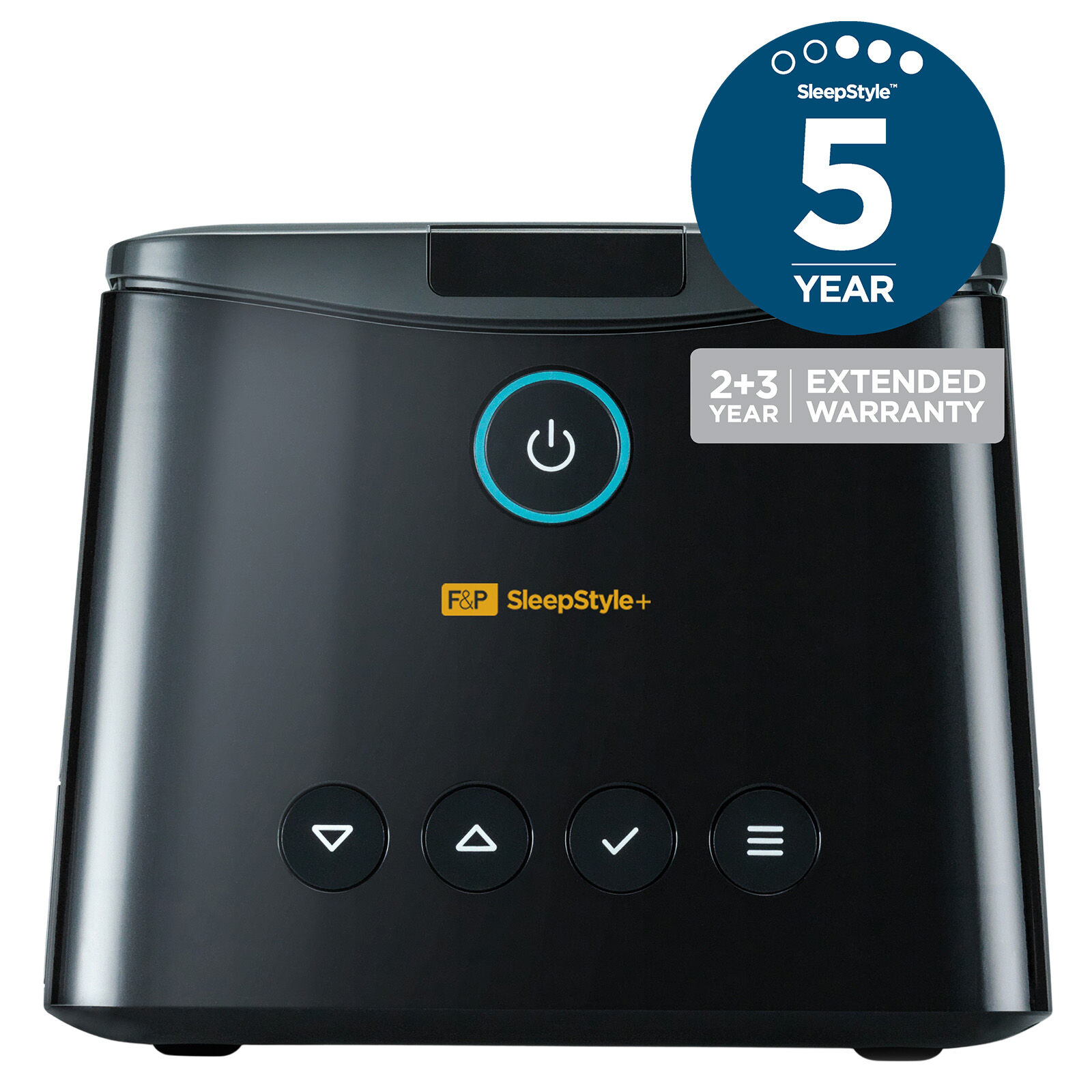
If your priority is a quiet, fuss-free machine that simply gets out of your way, the Fisher & Paykel SleepStyle+ Auto is our top pick for 2026. Fisher & Paykel built it around comfort and simplicity rather than feature density — and it shows in the details that matter at bedtime.
Why we love it (the pros)
- The quietest machine in our testing. It's rated around 28 dBA, but in our own testing it ran much quieter than that — closer to 23 dBA — with a soft, low motor note and no sharp whine or hum to pull you out of sleep. Just as importantly, the pump stays smooth and unobtrusive as it adjusts through the night, rather than audibly surging with your breathing. Beside the bed, it's the one our team and customers most often describe as "I can't even hear it." If a quiet night is what you're chasing, this is the machine to beat. (It's also a strong answer to that common search for the quietest CPAP machine in Australia.)
- Excellent humidification. F&P's ThermoSmart system is widely regarded as the gold standard in CPAP humidification. Sensors at both the humidifier and the mask end of the hose keep the air warm and moist all the way to your face, and the AirSpiral heated tube does a superb job of eliminating rainout — a real benefit on cold Queensland and southern-state mornings.
- An excellent, comfort-led algorithm. Beyond standard auto-adjusting pressure, the SleepStyle+ adds SensAwake™, which detects when you've woken during the night and gently eases the pressure to help you drift back off, plus Expiratory Relief that drops pressure each time you exhale so you're not "fighting the machine."
- The only CPAP machine with the American Arthritis Foundation's Ease of Use Commendation. That's not marketing fluff — it's an independent recognition for a genuinely accessible design. The controls are large, forward-facing and easy to press, and the water chamber pops out and clicks back in one-handed. If arthritis, reduced grip strength or dexterity is a concern, this is a meaningful, hard-to-beat advantage. You can read about the commendation on Fisher & Paykel's official SleepStyle page.
The one thing to know (the con)
- No 12V/24V DC input for portable use. The SleepStyle+ runs on AC power, so if you want to use it off-grid — camping, caravanning, or anywhere without mains power — you'll need an AC power source such as a portable power station with an AC outlet, or a battery paired with an inverter. There's no native 12V/24V DC option to plug straight into a car or deep-cycle battery. It's a small consideration for most people (and a non-issue if you only ever use it at home), but worth knowing if portable, power-independent therapy is part of your plans.
Best for: anyone who values a quiet bedroom and effortless daily use above all — and especially users who want the easiest possible machine to handle. Starting therapy from scratch? The SleepStyle+ comes in three ready-to-go mask packages so you're set up from night one — choose the full face mask package if you breathe through your mouth, the nasal mask package for a balanced all-rounder, or the nasal pillows mask package for the lightest, least intrusive fit.
#2 — ResMed AirSense 11 AutoSet: Australia's most-bought machine for good reason
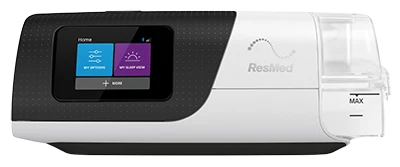
The ResMed AirSense 11 AutoSet is the highest-selling CPAP machine in the Australian market — and that popularity is well earned. It pairs one of the most clinically published auto-adjusting algorithms in the world with a modern, genuinely user-friendly design, making it the safe, versatile, do-everything choice for most people.
Why it's so popular (the pros)
- Australia's #1 purchased CPAP machine. When this many Australians (and their sleep clinics) land on the same machine, it tells you something about reliability, support and results. It's the default recommendation for a reason — proven, dependable, and backed by ResMed's well-established local service and warranty network.
- A touchscreen, not a dial. The AirSense 11 swaps the physical push-dial of the older AirSense 10 for a responsive colour touchscreen. Tapping and swiping is far kinder to stiff or sore fingers than twisting a dial — a quiet but real win for anyone with arthritis or limited dexterity, and simply more intuitive for everyone else.
- The AutoSet for Her algorithm is built right in. On the old AirSense 10 you needed a separate "For Her" device; on the AirSense 11 it's simply a mode in the menu. The AutoSet for Her setting is more sensitive to flow limitation and applies pressure changes gently — tailored to the way obstructive sleep apnoea more commonly presents in women. One machine, selectable from the menu, covering standard APAP, For Her, and fixed-pressure CPAP. You can read more on the ResMed Australia AirSense 11 page.
- Genuinely versatile. Three therapy modes in one device means your prescription can change over time — weight, seasonal congestion, a switch from fixed to auto — without buying a new machine. Add the integrated HumidAir 11 humidifier, ClimateLineAir 11 heated tube, 4G data tracking and the myAir coaching app, and it's hard to outgrow.
The one thing to know (the con)
- Some users find it a touch louder than the quietest models. Its rated ~27 dBA looks excellent on paper — fractionally lower than the SleepStyle+'s rating, even. But ratings and real-world noise don't always line up: in our testing the AirSense 11 measured slightly higher than its rating, while the SleepStyle+ measured well below its own — so the real gap between them is wider than the spec sheets suggest. A number of users notice a slightly more present hum from the AirSense 11 beside the bed, particularly light sleepers and sensitive partners. It's still a very quiet machine by any reasonable standard — just not quite the pin-drop silence of our #1 pick. For most people it's a non-issue; if you're noise-sensitive, it's worth weighing.
Best for: the widest range of users — anyone who wants a proven, flexible, well-supported machine, and especially women who'll benefit from the built-in For Her mode. The AirSense 11 AutoSet with nasal mask package gets you set up from night one.
SleepStyle+ vs AirSense 11 AutoSet at a glance
| Feature |
F&P SleepStyle+ Auto
|
ResMed AirSense 11 AutoSet
|
|---|---|---|
| Best known for | Quietest operation & ease of use | Versatility & proven algorithm |
| Noise | ~28 dBA rated; ~23 dBA in our testing — softest motor note | ~27 dBA rated; measured slightly higher in our testing |
| Humidification | ThermoSmart — gold-standard, sensor-controlled | HumidAir 11 with Climate Control |
| Controls | Large, easy-press buttons | Colour touchscreen (no dial) |
| Standout comfort feature | SensAwake responsive pressure relief | AutoSet for Her mode built in |
| Accessibility | Arthritis Foundation Ease of Use Commendation | Touchscreen — easy on stiff fingers |
| Off-grid power | AC only (no 12/24V DC input) | DC accessory options available |
| Data & app | SleepStyle app + InfoUSB / modem | myAir app + 4G + Personal Therapy Assistant |

The honest truth: you really can't go wrong
It's worth repeating, because it matters: every current auto CPAP machine on the market is a strong choice. The SleepStyle+ and AirSense 11 AutoSet are our two favourites, but they're standing at the front of a very good field. If a sleep clinician has already steered you toward a particular brand, or you've had a great run with a Philips DreamStation or a Löwenstein Prisma, those are excellent machines too. The "best" auto CPAP machine is ultimately the one you'll actually use every night — which usually comes down to a comfortable mask, the right pressure settings, and a machine that feels easy to live with. Browse the full range of auto pressure CPAP machines to compare every current model.
Frequently asked questions
What's the difference between a CPAP and an auto CPAP (APAP) machine?
A fixed pressure CPAP machine delivers a single set pressure all night. An auto CPAP — also called an APAP or auto-adjusting machine — works within a prescribed range and changes its pressure breath by breath based on what your airway needs. Most people with obstructive sleep apnea find APAP more comfortable, especially early in therapy, because the pressure tends to be lower and gentler when you're first falling asleep.
Which is the quietest CPAP machine?
In our testing the Fisher & Paykel SleepStyle+ has the softest, least intrusive sound beside the bed — it measured around 23 dBA, noticeably quieter than its ~28 dBA rating, while the AirSense 11 AutoSet measured slightly above its own ~27 dBA rating. Rated decibels only tell part of the story for two reasons: they're measured at a single steady pressure, and an auto machine's pump speeds up and slows down all night as your breathing changes — so a machine can be quiet at rest yet have an audible rise-and-fall to its motor. The SleepStyle+ stands out on both counts: a low measured volume and a smooth, even pump that doesn't surge with your breathing.
Do I need a prescription to buy an auto CPAP machine in Australia?
A prescription isn't required to purchase an auto CPAP machine in Australia. That said, if your sleep specialist has given you a pressure range, it's worth having the machine pre-configured to those settings before you start. You can upload your prescription at checkout and we'll set it up before dispatch. If you don't have a range yet, both machines ship with a clinically standard default that suits most users.
Is the ResMed AirSense 11 AutoSet better than the SleepStyle+ for women?
For users who specifically want a clearly labelled AutoSet for Her algorithm — designed around the flow-limitation patterns more common in women with mild-to-moderate OSA — the AirSense 11 AutoSet has the edge, since that mode is built right into the menu. That said, the SleepStyle+ isn't far behind: Fisher & Paykel's auto-adjusting algorithm is genuinely clever and responds to those same subtle changes in breathing and flow limitation automatically, without needing a separate mode. Both machines deliver excellent therapy for women — the difference is that ResMed makes the For Her tuning a selectable option you can see in the menu, while F&P bakes that responsiveness into how its algorithm reads you all night.
The bottom line
For 2026, our two standout auto CPAP machines are the Fisher & Paykel SleepStyle+ Auto for the quietest, easiest, most comfort-led experience, and the ResMed AirSense 11 AutoSet for proven, flexible, do-everything therapy and the built-in For Her mode. You genuinely can't go wrong with either — it comes down to whether silence and simplicity or versatility and a touchscreen matter most to you. Not sure which way to lean? Compare both machines side by side or get in touch with our team and we'll help match a machine to your prescription and sleep style — with genuine Australian stock and full local warranty, shipped Australia-wide.