
 Kingon P2-E Alert Codes: What Each One Means and What to Do
Every concentrator in the Kingon P2-E range monitors itself continuously and will tell you when something is wrong — through the alert light on the front panel and a code on the display. This page lists all 23 alert codes, what each one means, and what to do about it. The codes are identical across the Kingon P2-E, P2-E6 and P2-E7, so whichever of the three you own, this is your reference.
Before you troubleshoot anything
If you feel breathless, light-headed, confused or unwell, treat that as the emergency — not the alarm. Switch to your backup oxygen supply if you have one and seek medical help immediately. In an emergency call 000.
An alert code tells you what the machine has detected. It does not tell you whether you are getting enough oxygen. If you have a pulse oximeter, check your saturation — and act on how you feel and what it reads, not on whether the alarm has cleared.
Reading the Front Panel
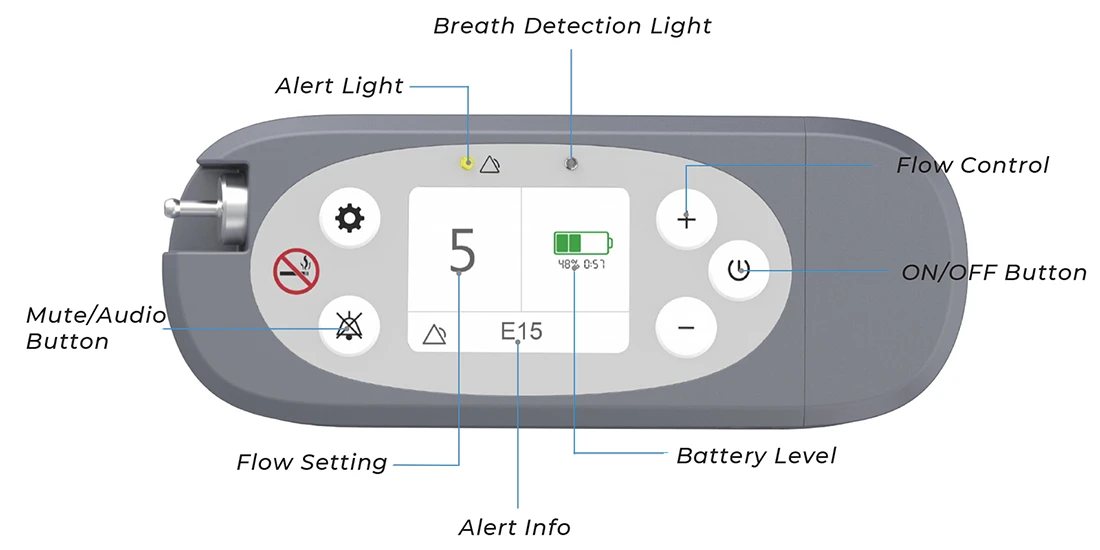
Before working through codes, it helps to know what the panel is telling you. The Kingon P2-E display shows your current flow setting, battery level and any active alert code. Alongside it you will find:
- Breath detection light — flashes each time the unit senses you inhale and delivers a pulse. If this is not flashing while you breathe through your nose, the machine is not detecting you.
- Alert light — illuminates when a fault or warning is active.
- Mute / audio button — silences the audible tone. Silencing an alarm is not the same as resolving it, so read the code before you mute it.
- Flow control — adjusts your pulse setting. Only change this if your prescriber has told you to.
All Kingon P2-E Range Alert Codes
Codes run E01 to E17. The "system response" column tells you whether the machine will keep running or shut itself down — shutdowns happen ten seconds after the alert begins.
| Code | Meaning | What triggers it | System response | What to do |
|---|---|---|---|---|
| E01 | Power supply fail | System voltage below 10.5V | Shuts down after 10 seconds | Connect to mains power or fit a charged battery. |
| E02 | System startup fail | Oxygen concentration below 87% after startup | Alarm only | Turn the unit off and restart it. Contact your supplier if the alarm continues. |
| E03 | Gas supply fail | Flow or concentration below normal range | Alarm only | Check the cannula and tubing for blockages or kinks, then restart. |
| E04 | Battery overheating | Battery above 65°C | Shuts down after 10 seconds | Turn off and let the battery cool before restarting. |
| E05 | System overheating | System above 60°C | Shuts down after 10 seconds | Turn off, check the vents are clear and unobstructed, and allow the unit to cool. |
| E06 | Battery temperature low | Battery below 0°C | Alarm only | Move somewhere warmer and let the battery reach room temperature. |
| E07 | System temperature low | System below 0°C | Alarm only | Bring the unit to room temperature before operating it. |
| E08 | Battery depleted | Charge below 5% with no power adapter | Shuts down after 10 seconds | Recharge immediately or connect to a power supply. |
| E09 | Cooling fan failure | Fan malfunction detected | Shuts down after 10 seconds | Turn off and contact your supplier for service. |
| E0A | Valve check failure | Valve switch malfunction | Shuts down after 10 seconds | Turn off and contact your supplier. |
| E0B | Compressor failure | Compressor malfunction | Shuts down after 10 seconds | Turn off and contact your supplier. |
| E0C | Sieve bed failure | Sieve bed fault or invalid operation | Shuts down after 10 seconds | Turn off and contact your supplier for inspection. |
| E0D | Tank pressure failure | Tank pressure fault detected | Alarm only | Turn off and restart. Contact your supplier if it continues. |
| E0E | Gas obstruction | Pipe or nasal cannula blocked | Alarm only | Check the cannula connection and restart. Contact your supplier if it continues. |
| E0F | Gas delivery failure | No gas delivery detected after injection | Alarm only | Make sure the cannula is connected correctly, then restart. |
| E10 | Oxygen sensor failure | Sensor malfunction detected | Alarm only | Turn off and contact your supplier. |
| E11 | Breath sensor failure | Sensor fault, or cannula kinked | Alarm only | Check cannula position and look for kinks. Contact your supplier if it continues. |
| E12 | Low oxygen concentration | Below 50% for more than 10 minutes | Alarm only | Stop using the unit and contact your supplier immediately. |
| E13 | Low battery | Charge between 5% and 20% | Alarm only | Recharge as soon as you can, or swap to your second battery. |
| E14 | Low oxygen concentration | Below 87% for more than 10 minutes | Alarm only | Check the cannula and restart. Contact your supplier if it continues. |
| E15 | Absence of breath | No breath detected for over 60 seconds | Alarm only | Check cannula position and breathe normally through your nose. If it continues, seek assistance or contact your supplier. |
| E16 | Low input voltage | Power adapter input below 17V | Switches to battery power | Check the adapter connection, or continue on battery. |
| E17 | Battery exhausted | Over 500 charge cycles, or health below 50% | Alarm only | Contact your supplier to arrange a replacement battery. |
The Codes You're Most Likely to See
Most alerts owners encounter day to day are not faults at all — they are the machine telling you something about power, temperature or the cannula.
E13 and E08 — battery running down
E13 appears between 5% and 20% charge as a warning. E08 fires below 5% and shuts the unit down ten seconds later. Neither indicates a fault. The P2 ships with two batteries precisely so you can swap rather than stop, and both an AC supply and a car DC supply are included so you can charge on the move.
E0E, E0F and E11 — usually the cannula
Three codes point at the same short list of causes: a kinked line, a cannula that has worked loose, tubing trapped under a chair leg or a strap, or a blockage. Before assuming a fault, disconnect and reconnect the cannula, run the tubing through your fingers along its full length, and check nothing is sitting on it. Cannulas are consumable and do perish — replace them on schedule rather than waiting for an alarm.
E03 is worth treating separately. It can be triggered by restricted flow, in which case the checks above apply — but it can equally be triggered by oxygen concentration dropping below the normal operating range, which points at the machine rather than the tubing. Check the cannula first, and if E03 returns after a restart, contact your supplier rather than continuing to use the unit.
E05 — overheating
The P2 draws cooling air through vents on the housing. Running it inside a closed bag, on a car seat in summer sun, or pressed against soft furnishings will eventually trigger E05. Keep the vents clear, and if you carry the unit in its case, make sure the mesh panel faces outward. Clean or replace the air filters on schedule — a clogged filter makes the unit work harder and run hotter.
E15 — no breath detected
The P2 is a pulse dose device: it releases oxygen when it senses you inhale. E15 means it has sensed nothing for 60 seconds. Usually the cannula has shifted, or you have been breathing through your mouth. Reseat the cannula and breathe through your nose. If you cannot clear it and you feel unwell, treat it as urgent and seek help.
Codes That Mean Stop and Call
Some codes are not user-serviceable, and attempting to work around them risks both the device and your therapy. Contact your supplier without restarting repeatedly if you see:
- E12 — oxygen concentration below 50% for over 10 minutes. Stop using the unit.
- E0B — compressor failure.
- E0A — valve check failure.
- E0C — sieve bed failure.
- E09 — cooling fan failure.
- E10 — oxygen sensor failure.
Repeatedly restarting a unit showing one of these will not fix it, and in the case of E12 it means continuing to breathe air that is not meeting specification. The Kingon P2-E range carries a three-year standard warranty, extending to five years when the device is registered within 14 days of purchase, with 12 months on the battery and sieve bed.
Parts That Wear Out
Three alerts are the machine telling you a consumable has reached the end of its life rather than reporting a fault.
- E17 — battery. This triggers after 500 charge cycles or when battery health drops below 50%. Charging once a day, that works out to roughly 16 to 18 months. It is the clearest replacement schedule the P2 publishes, and worth budgeting for.
- E0C — sieve bed. The sieve bed separates oxygen from the air drawn in, and its material degrades over time, particularly in humid or dusty conditions. The P2's is a modular design intended to be replaced rather than sending the whole unit away.
- E05 and E09 — filters and airflow. Not filter codes as such, but a clogged filter drives both. The P2 ships with a set of five air filters for this reason.
[PAGE NOT FOUND — link to Kingon P2-E spare batteries, sieve beds, cannulas and filter packs once those SKUs exist]
Frequently Asked Questions
Alarm-only codes generally clear once the underlying condition is resolved — reseat the cannula, connect power, or let the unit reach room temperature. Codes that shut the device down require you to fix the cause and then restart it. Muting the alarm only silences the tone; it does not address whatever triggered the code.
It depends entirely on the code. A low battery warning (E13) is informational and you can keep going.
Two codes both read as low oxygen concentration and they are not equally serious. E14 means concentration has been below 87% for more than 10 minutes — check the cannula and restart, and contact your supplier if it returns. E12 means concentration has been below 50% for more than 10 minutes, which is well outside therapeutic range: stop using the unit and contact your supplier immediately.
If in doubt, check your oxygen saturation and how you feel rather than relying on the machine to decide for you.
E15 means the breath sensor has not detected an inhale for 60 seconds. The usual causes are a cannula that has shifted out of the nostrils, mouth breathing, or a kink in the line. It is a detection problem far more often than a breathing problem — but if you cannot clear it and feel short of breath, treat that as urgent.
The E17 alert triggers after 500 charge cycles or when battery health falls below 50%. Charging once a day, most users will reach that in roughly 16 to 18 months. Runtime tailing off well before the usual point is the earlier, softer warning.
If it happens once and does not return, note the code and the date. If it recurs, report it. Alert codes are the device working as designed, and raising a recurring one early — rather than working around it for months — gives you the clearest path if the unit does need service under warranty.
While You Are Here
Several of the codes above come back to where and how the machine is running — a blocked intake, a hot room, a covered vent. Those are the same conditions our guide to using oxygen safely at home is built around, along with the fire precautions, blackout planning and life support registration that matter more than any single alert code. Worth reading once properly.
Still Stuck?
If you have worked through the code above and the alert has not cleared, get in touch rather than persisting — oxygen therapy is not something to troubleshoot indefinitely on your own. Kingon devices are supported through an Australian service network, so a repair does not mean shipping your concentrator overseas.
Looking at the range rather than troubleshooting one you own? The Kingon P2-E portable oxygen concentrator is the 1.98kg pulse dose model these codes apply to.
If you use supplemental oxygen alongside CPAP therapy, note that a pulse dose concentrator cannot supply a CPAP circuit — that setup needs a continuous flow source joined to the circuit through an oxygen port or enrichment adapter. And if you are heading away, our guide to travelling with CPAP and oxygen equipment covers battery planning and airline paperwork.
Oxygen is a prescription therapy
Supplemental oxygen must only be used in line with a prescription from a qualified medical practitioner. If an alert has prompted you to change your flow setting, speak with your prescriber first — pulse settings are not litres per minute, and setting 3 does not mean 3 LPM. Have your setting verified with a pulse oximeter at rest and across your normal range of activity, and keep a backup oxygen supply available in case of a power outage or fault.